

Introduction
When preparing for C# and .NET interviews, one of the most asked topics is Delegates, Func, Action, and Predicate. These concepts may look confusing at first, but once you understand them, they’ll make your coding life easier. Delegate in C# are one of the most important and basic concepts.
Think of Delegates as function containers. They allow you to treat methods like variables — you can pass them around, store them, and execute them whenever you want.
Also, check out the other Interview Questions & Answers Set:-
- Interview Set 1: 10 .NET Core Interview Questions & Answers.
- Interview Set 2: .NET 8 & .NET 9 Interview Questions and Answers.
- Interview Set 3: Top 10 .NET Interview Questions on CLR, CTS, and CLS (With Detailed Answers)
- Interview Set 4: Middleware Interview Questions in ASP.NET Core
- Interview Set 5: Top 15 Dependency Injection Interview Questions & Answers
Let’s break this down step by step 👇
1. What is a delegate in C#, and why is it used?
A delegate in C# is a type that holds a reference to a method with a specific signature. It acts like a pointer to a function but is type-safe. Delegates are mainly used for callbacks, event handling, and passing methods as parameters.
👉 Example:
public delegate void PrintDelegate(string msg);

class Program
{
    static void Print(string msg) => Console.WriteLine(msg);

    static void Main()
    {
        PrintDelegate pd = Print;
        pd("Hello from Delegate!");
    }
}2. Explain the difference between a delegate and an event in C#.
- A delegate is a type that represents references to methods.
- An event is a wrapper around a delegate that provides publish/subscribe mechanism and adds encapsulation and security.
👉 In short:
- Delegate → function pointer.
- Event → delegate with restricted access (cannot be invoked directly outside the class).
3. How does Func differ from Action in C#?
- Func in C# → Always returns a value. Last type parameter is the return type.
- Action in C# → Always returns void.
👉 Example:
Func<int, int, int> add = (a, b) => a + b;  // returns int
Action<string> greet = (name) => Console.WriteLine($"Hello {name}"); // no return4. When would you use Predicate over Func?
- Predicate in C# is a special delegate that always takes one parameter and returns a bool.
- Use Predicate when you specifically want a true/false condition check (e.g., filtering collections).
👉 Example:
Predicate<int> isEven = num => num % 2 == 0;
Console.WriteLine(isEven(4)); // True5. Can a delegate point to multiple methods? Demonstrate with code.
Yes ✅ A delegate in C# can reference multiple methods. This is called a multicast delegate.
👉 Example:
public delegate void Notify();

class Program
{
    static void Method1() => Console.WriteLine("Method1 executed");
    static void Method2() => Console.WriteLine("Method2 executed");

    static void Main()
    {
        Notify notify = Method1;
        notify += Method2;  // multicast
        notify();
    }
}6. What is a multicast delegate? Give an example.
A multicast delegate in C# is a delegate that holds references to multiple methods. When invoked, all methods are executed in the order they were added.
👉 Example:
delegate void LogDelegate(string msg);

class Program
{
    static void LogToConsole(string msg) => Console.WriteLine($"Console: {msg}");
    static void LogToFile(string msg) => Console.WriteLine($"File: {msg}");

    static void Main()
    {
        LogDelegate log = LogToConsole;
        log += LogToFile;
        log("Delegates are cool!");
    }
}7. What are the advantages of using built-in delegates (Func, Action, Predicate)?
- Reduces boilerplate code (no need to define custom delegate types).
- Improves readability and maintainability.
- Widely used in LINQ, collections, and lambda expressions.
- Makes code reusable and flexible.
8. Write a code example where you use Func for a calculation.
👉 Example:
Func<int, int, int> multiply = (x, y) => x * y;

class Program
{
    static void Main()
    {
        int result = multiply(4, 5);
        Console.WriteLine($"Result: {result}");
    }
}
✅ Output:
Result: 209. How can delegates improve testability in C# applications?
Delegates allow you to pass different method implementations at runtime, which helps in dependency injection and mocking during unit testing.
👉 Example: Instead of hardcoding logic, you can pass a delegate function to test different scenarios without changing the core code.\
10. Explain covariance and contravariance in delegates with an example.
- Covariance → Allows a delegate to reference a method that returns a more derived type than specified.
- Contravariance → Allows a delegate to accept parameters of a less derived type.
👉 Example:
class Animal {}
class Dog : Animal {}

delegate Animal AnimalHandler();

class Program
{
    static Dog GetDog() => new Dog();

    static void Main()
    {
        AnimalHandler handler = GetDog; // covariance
        Animal a = handler();
    }
}🎯 Final Note
These Delegates, Func, Action, and Predicate interview questions are not just theory — they appear in real-world .NET projects and coding interviews. Mastering them will give you a strong edge in your C# and .NET Core interview preparation. 🚀
Conclusion
Delegates, Func, Action, and Predicate are powerful tools in C# that make code more flexible and reusable.
- Delegates → General method references.
- Func → Methods that return a value.
- Action → Methods that return nothing.
- Predicate → Methods that return true/false.
Mastering these will not only help in interviews but also in real-world C# projects. 🚀
Let’s Connect
I hope this article about interview Questions on delegates in ASP.NET Core helps you grow in your .NET developer interview in 2025 and beyond. I regularly share coding resources, learning roadmaps, project ideas, and career tips across multiple platforms. If you found this helpful, consider following me and joining the Logic Lense community!
-
Instagram – @logiclense
-
YouTube – Logic Lense
-
LinkedIn – Connect with me
-
Website – www.logiclense.com
Let’s code, grow, and innovate — together. Happy Learning!!!
Browse the Ebooks for ASP.NET Core Developers
-
Sale!
 ASP.NET Core
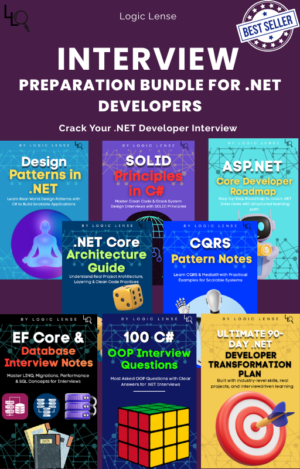
Complete Interview Preparation Bundle for .NET Developers
₹999Original price was: ₹999.₹598Current price is: ₹598. Add to cart -
Sale!
 ASP.NET Core
.NET Interview Complete Notes
₹499Original price was: ₹499.₹199Current price is: ₹199. Add to cart -
-

Subscribe to ASP.NET Core Newsletter.
Want to advance your career in .NET and Architecture? Join 1,000+ readers of my newsletter. Each week you will get 1 practical tip with best practices and real-world examples.


